vendredi 1 mai 2015

Baltimore and Non Sequiturs


Today's vocabulary lesson

Non sequitur: a conclusion or statement that does not logically follow from the previous argument or statement.

Example:
Black person: We want the police to stop shooting our unarmed black men, we want transparency, accountability and justice.

White person: What about the culture of criminality, low test scores and out-of-wedlock births?


In this examples, a black person is talking about a serious issue, that is well documented and that must be a terrifying and demoralizing reality to have to live with. They are also suggesting a possible solution to the aforementioned problem. The white person in this example (#notallwhitepeople) has dismissed the problem and the suggested remedy and brought up an entirely different set of issues that are immaterial to the subject at hand while also playing with racial stereotypes that could only be gleaned through popular media, which as we know, is mostly controlled by the same types of white people who would offer this sort of retort and also have little knowledge of actual black people. The point of the entire exercise is to derail the conversation and in a cruel sleight of hand to put the blame on the marginalized for their own discrimination. So let me put a few ideas to rest:

1. There is no black culture of criminality, there is just criminality
2. There is no such thing as black on black crime, there is just crime
3. There is no such thing as a black culture of dependency and entitlement
4. There is no such thing as black leaders, we do not hold votes, we did not pick Al Sharpton; he is just a media personality, no more a black leader than O'Reilly is a white leader
5. Drug use and selling is no higher in the black community than in the white community and may very well be lower (this is anecdotal but I did go to college)
6. And not to contradict my last point, there is no monolithic black community
7. Thug is racist, any word that can only be used for one race and mostly said by old white men should be fairly obvious

And the last one, which I would like to spend more time on is this notion that black people HATE education. I had this idea for an Onion headline yesterday "Black Grandmother Disappointed to Learn Grandson First in Family to Graduate College". This came to mind as I was thinking, could you find a single grandmother who wouldn't be immensely proud of their family member for achieving that goal, and worse would be deeply disappointed.

When I was growing up all black people around us talked about was doing well in school, and fretting over, the mostly boys, who weren't doing well and staying out of trouble. As an aside, when I was a child I spent most of my time, when we were not on the military base, with black people living in the poorer parts of town, not knowing there were areas with large white populations in cities like Jacksonville and Tampa, Florida or DC. To continue, there is probably nothing that black people care about more and talk about more than good jobs for themselves and good schools for their kids. We built black universities when we couldn't get into white universities. The first civil rights battle was for school desegregation, not voting, not interracial marriage, not housing, but good schools for black kids. Our schools are failing our kids and the majority culture couldn't care less. I think it’s important to note that black people are some of the biggest victims in the for profit university scams. We are clamoring for quality education and it is falling on deaf ears.  

Black people left the South, one of the largest migrations in the US, to escape state sponsored racist violence and to seek opportunity in industrialized cities. My own family was a part of that migration to the North ending up in places like Worcester (another place that I thought was all black growing up), Philadelphia, Trenton and Baltimore all living in what are now majority black inner cities. I spent a lot of time visiting my uncle in Baltimore during the 90s and I saw firsthand, though I didn't fully understand what I was seeing until much later, the implications of almost a century of policies that have injured the residents of that city: redlining, de-industrialization, globalization, sub-prime mortgages, the drug war, mass incarceration, and simple neglect.

What do black people want, some ask. The same things we have always wanted. Good jobs, good schools, good police and fair policies that uplift and not crush. Black people are not looking for handouts and we most certainly do not have a sense of entitlement, this idea would be laughable if it weren't so insidious. I am always disheartened when I hear a certain subset of white people talk about black culture as a list of pathologies, because black culture for me is just not that. My black culture is persevering despite the odds, working twice as hard and being twice as good just to get to the starting line, knowing that troubles don't last always, that you may not have much but you've got your health.  

Freddie Gray
My heart goes out to the people of Baltimore, I remember your city as a gritty place very much different from my suburban environment in neighboring Virginia, but I have lots of good memories from that time. I will leave you with one of my favorite memories.

My uncle is a minister in Baltimore and we used to go up quite regularly and of course would go to church. At the time there was a classically trained Russian pianist and his wife, a cellist, who were attending the church. The man had come to learn how to play gospel music, which I imagine was difficult to do in Russia. I was fascinated by this couple who would play classical pieces for the black congregation and then he would do his best to play gospel. Once after church we stayed late and I showed him some of the classical pieces I had been working on, most likely Beethoven's Moonlight Sonata. He praised me telling me that I was very talented and gave me some tips of improving my speed, the best part was my mother, a gospel pianist, turned and saw me sitting at the piano, and said she hadn't even realized the classically trained Russian had gotten up and that it was me playing. Needless to say I was over the moon... light Sonata, (sorry couldn't help it). But later in life I was struck by this white Russian couple who came to this struggling black city to absorb and be immersed in a part of my culture that I myself gave little value, and they weren't afraid that just the sight of their white skin would send the black residents into a murderous frenzy like a pack of wild hyenas. They were a quiet couple that was loved by the church and were welcomed with open arms. That epitomizes black culture for me.

So please, stop with the non sequiturs, learn something about us from us. Listen to your black friend, and be open to new experiences, new sounds, new voices, and new perspectives. They are not a threat to you, they are an opportunity. Let my uncle’s congregation be an example, you may not be familiar with the music, or no its history or its composer, but you can sit back and enjoy the beauty of the melody. 

Vocabulary lesson over.

lundi 23 février 2015

Arabic Word Stump of the Day: Sahafa

Usually while studying Arabic, I can make the link between ancient meanings and modern usage of certain root forms, but the word for "newspaper" has thrown me for a loop. Newspaper in Arabic is, sahifa, the root of course being shf, which also gives us other modern concepts, such as journalism, and journalist. The verb sahhafa however, means exactly what you should not do if you are working in the "news business". It means, to misread, mispronounce, misspell, distort and twist; in fact, absolutely everything you should not do. 

If anyone can explain this one to me that would be great, because this one has me stumped. Unless of course, you go with the simple answer, which is the Arab speaking world has hipstered us and went with irony when choosing a word for journalism realizing the true nature of journalism as distortion and wanted to make it explicit. At any rate, this will be a very useful root. It has two very precise meanings that I will use often. I will probably frequently talk about newspapers and journalism, and in Arabic I will also frequently mispronounce, misread and misspell.

jeudi 5 février 2015

In 30 Days or Less: Opportunity Abounds in Marrakesh

The city and mountain view
from my office window. 
Well it seems that my meeting last Friday is working out. I am still a little overwhelmed by how quickly things are moving and don't want to jinx anything. But I was sitting in my new office across from my supervisor who was telling our partners in Brazil about his new intern, so I guess I can spill the beans.

I was hoping to at least volunteer for this organization called ALCS here in Marrakesh, maybe a few hours a week and see what I could do to help. After looking over my resume the director, who had previously been open to the idea but not jumping out of her seat started to get excited and jumped out of her seat. She scanned my resume and sent it to another sister organization, ITPC MENA. The head guy there immediately responded and asked to meet me right away, that very day, that very hour if possible. So I met him and he seemed very happy that I just walked in off the street and was sure there was a way for us to collaborate. Later that day I received an email from him saying he wanted more than a volunteer, so for the moment he could offer me a two-month paid internship/apprenticeship and was quite optimistic that a paid long-term agreement could be reached within that time-frame.

I have a feeling that he wanted to at least offer me an internship to make sure I didn't keep looking. It was more than I expected when I walked into the ALCS office on Friday. I gave myself two months to find something interesting and important to do in Marrakesh, as I read that was the average for other expats. So I am kind of proud of myself for making it happen in 30 days. My new supervisor was worried that I might think it strange how fast things are moving, but he assured me that he was looking for someone just like me and never expected me to just walk in off the streets looking to help in some way. He was already planning to advertise at US universities. It's an amazing feeling when the organization you are looking for is looking for someone like you. You feel the connection immediately. And the promise of plenty of work and travel is not too bad either. So unofficially, because that's how fast all this has been moving and there hasn't been time to come up with a title, I am the new Regional Advocacy Assistant for the Middle East and North Africa at the International Treatment Preparedness Coalition Middle East North Africa. It probably won't fit on one business card. 

My office. The orange chair is mine.
Changing soon I hope.
Today was my second day, so presentation of the organization and a look at the newest project, and another meeting probably next week to define my role and tasks. I have a lot to learn about a completely new thematic area and the opportunity to make new friends and learn Arabic which is exciting. I am looking forward to this experience, and Mika of course is cautiously optimistic as he want to extend his stay in Marrakesh as well. So thank you everyone for your support and words of encouragement when I was feeling down. All this is a bit too perfect, but I intend to enjoy this moment and see how far it will take me.

vendredi 5 décembre 2014

System Failure by Design: History of Race in America

Ce résumé n'est pas disponible. Veuillez cliquer ici pour afficher l'article.

jeudi 6 novembre 2014

Positive Spin on Democratic Defeat

I know many of you are upset about the recent elections and the idea of a Republican Senate, but I thought I would share a positive perspective on things. For one, Democrats always do poorly during off year elections, and this loss comes as no surprise. Regardless of what you think of Bill Clinton's presidency, both houses were under Republican control almost his entire tenure. This said, when Democratic candidates win presidential elections that usually spells big wins for Democrats, and when one party has too many seats there is usually a big correction during a presidential election. So with a Hillary run, there is a chance that a dramatic restructuring of both houses will occur in 2016, especially if Warren is on the ticket, my secret wish, to energize the youth vote and especially if the Republicans don't have a credible candidate to run against her, which at the moment seems to be the case. 

But I think the ballot measures were very promising and I was glad to see some very conservative measures voted down in referenda and liberal measures passed. Personhood amendments, that would pretty much outlaw abortion, failed in even deep red states, and marijuana legalization passed in more liberal states, but minimum wage increases were extremely popular in both blue San Francisco and red Arkansas. Gerrymandering has probably benefited Republican candidates in this election, even though the electorate tends to be older, whiter and more conservative, but the electorate showed itself to be center-left when asked to vote on drugs, abortion and minimum wage increases directly where there Gerrymandering effect is negated. So that is a strategy that progressives should keep in mind for future elections. 

Another high point, judging from the lack of referenda on the topic; the gay marriage debate seems to be over, with pro-equality Republican candidates being reelected and more coming out for gay rights. Republican candidates, appealing to their base, in gerrymandered districts, seem to be more conservative than the electorate that votes for them. That is a positive development and is something to keep in mind as we go into 2016.

Post Election Minimum Wage Rant

I want to congratulate all the states and cities that voted to increase their minimum wage, from blue San Francisco to red Arkansas. Americans overwhelmingly support a living wage and were not deterred by scare tactics or rampant inflation and high unemployment. The purpose of the minimum wage was indeed to provide a basic standard of living for those at the bottom of the income scale. It was wholly and utterly progressive. People who work full-time shouldn't starve.

The only reason we don't see the full effects of poverty wages is because so many people who work minimum wage jobs qualify for assistance; something that many who don't want to raise wages also want to scale back. Looking at inflation data, an indicator of where prices are going, the last increase in 2009, rates were within historical averages, if not slightly lower. Which indicates there is no real effect on prices. Unemployment peaked in 2010, .3 points higher than 2009, but considering the state of the economy, probably had little to do with the increase, and the unemployment rate has been falling since. So it doesn't affect prices and it doesn't affect employment, it spurs economic activity and it gives people dignity.

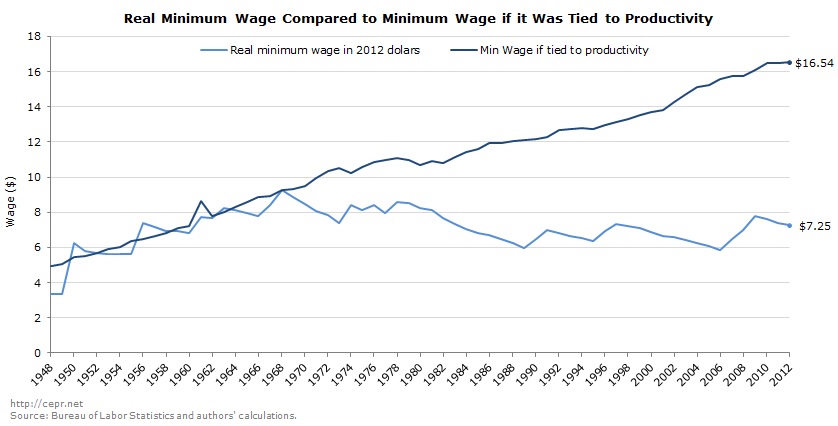
A low minimum wage also has the nefarious effect of affecting everyone up the wage scale who works for their pay, around 5% make the bare minimum or below, but it sets a benchmark for all other wages to be compared to. Someone with a four-year degree makes the equivalent of what a minimum wage worker made in the 60s. If wages had kept pace with productivity and inflation the minimum wage would be nearly $20, so what would a college grad be making? We haven't been too good about raising the minimum wage, yet prices still increase, productivity still increases. So I would like someone to show me the link between a raise in the minimum wage and all these negative effects, because the data doesn't reveal that.

When I was in Paris a Chipotle opened up and I was surprised that a burrito cost $13. But then I thought, these workers are well-paid, probably living in decent apartments in the suburbs, they have stable full-time schedules, they have health insurance, and paid vacation, and the line was still going out the door. In the US we accept crap and think its ok that the people who serve it to us should live like crap. When you travel in Western Europe you realize how poor the average American is, despite how insanely rich our country is, our housing in sub-par, we are sicker, we don't take vacations. Look at CEO pay and productivity, which grow exponentially and compare it to real wages, which continually fall. That's not ok to me, at all.

If income inequality is the issue of our time, and its getting worse, then what other solution is there than raising taxes and raising the minimum wage, which was designed to provide the least skilled workers a dignified minimum standard of living; a living wage. We may still worship at the alter of upward mobility, bootstraps and ambition, but the US is increasingly the least socially mobile country, has the most entrenched wealth, and the highest income inequality.

People are suffering and need relief and they could care less about proving their mettle at the fry station when they know they are going to leave their full-time job with their food-stamps and head to Walmart. If service jobs are the new mining and factory jobs then for the sake of workers and for the economic health of the US they need to be living wage jobs.

vendredi 3 octobre 2014

My Take on the Death of the Middle Class

I was reading some articles on the death of the middle class and the reasons why, I will post here below. Also some articles on the hidden rich in America, and I decided to do some quick calculations. I googled who the richest actor is, people we generally think of as the richest of the rich, Seinfeld topped the list at 825 million. Then I looked up simply the richest American, and no surprise it was Bill Gates at 81 billion. So 100x more than the richest actor.

I also read in one of the articles that the starting wage in the early 60s in say a steel mill, shoveling coal into a furnace for 8 hours payed in today's dollars $17/hour. Essentially an annual salary of $32,000 today. Some of you might be thinking that looks like the average starting salary for an entry level position requiring a Bachelors. Because I did. Which leads me to one of two conclusions: 1. jobs are vastly underpaid for the skills and education they require and employers are getting a great deal on labor; or 2. jobs require a bachelors degree the way that jobs of yore only required a high school diploma.

We need to figure out why our skills and education, which are harder and harder to come by, keep losing value, or we need to make undergraduate education free again (like it mostly was in the 60s) as it is the new minimum. Although that doesn't take into account fast food and retail, unless you add the loss of unions into the mix. Some economists want to scare us into believing that if we raise the minimum wage, which would be $20 today had it kept up with inflation, we would have high prices and fewer jobs, but the only tangible result I can see from all the data I have looked at shows the ability to lower wages at the low end of the wage scale drags all other wages down with it.

Now we are at a point where a computer programmer fresh out of college in 2014 can expect to make the same amount as a high school drop-out shoveling coal into a furnace in 1962 who walked in off the street. And the kicker, the computer programmer in 2014 probably has about $35,000 in student loans to pay back.

http://www.salon.com/2013/09/20/rip_the_middle_class_1946_2013/

http://www.salon.com/2013/12/30/the_middle_class_myth_heres_why_wages_are_really_so_low_today/

http://www.salon.com/2014/07/21/clueless_rich_kids_on_the_rise_how_millennial_aristocrats_will_destroy_our_future/

http://www.salon.com/2014/09/29/the_big_middle_class_rip_off_how_a_short_sale_taught_me_rich_peoples_ethics/