Usually while studying Arabic, I can make the link between ancient
meanings and modern usage of certain root forms, but the word for
"newspaper" has thrown me for a loop. Newspaper in Arabic is, sahifa,
the root of course being shf, which also gives us other modern concepts,
such as journalism, and journalist. The verb sahhafa however, means
exactly what you should not do if you are working in the "news
business". It means, to misread, mispronounce, misspell, distort and
twist; in fact, absolutely everything
you should not do.
If anyone can explain this one to me that would be
great, because this one has me stumped. Unless of course, you go with
the simple answer, which is the Arab speaking world has hipstered us and
went with irony when choosing a word for journalism realizing the
true nature of journalism as distortion and wanted to make it explicit. At any rate, this will be a very useful root. It has two very precise meanings that I will use often. I will probably frequently talk about newspapers and journalism, and in Arabic I will also frequently mispronounce, misread and misspell.
lundi 23 février 2015

jeudi 5 février 2015
In 30 Days or Less: Opportunity Abounds in Marrakesh
 |
| The city and mountain view from my office window. |
I was hoping to at least volunteer for this organization called ALCS here in Marrakesh, maybe a few hours a week and see what I could do to help. After looking over my resume the director, who had previously been open to the idea but not jumping out of her seat started to get excited and jumped out of her seat. She scanned my resume and sent it to another sister organization, ITPC MENA. The head guy there immediately responded and asked to meet me right away, that very day, that very hour if possible. So I met him and he seemed very happy that I just walked in off the street and was sure there was a way for us to collaborate. Later that day I received an email from him saying he wanted more than a volunteer, so for the moment he could offer me a two-month paid internship/apprenticeship and was quite optimistic that a paid long-term agreement could be reached within that time-frame.
I have a feeling that he wanted to at least offer me an internship to make sure I didn't keep looking. It was more than I expected when I walked into the ALCS office on Friday. I gave myself two months to find something interesting and important to do in Marrakesh, as I read that was the average for other expats. So I am kind of proud of myself for making it happen in 30 days. My new supervisor was worried that I might think it strange how fast things are moving, but he assured me that he was looking for someone just like me and never expected me to just walk in off the streets looking to help in some way. He was already planning to advertise at US universities. It's an amazing feeling when the organization you are looking for is looking for someone like you. You feel the connection immediately. And the promise of plenty of work and travel is not too bad either. So unofficially, because that's how fast all this has been moving and there hasn't been time to come up with a title, I am the new Regional Advocacy Assistant for the Middle East and North Africa at the International Treatment Preparedness Coalition Middle East North Africa. It probably won't fit on one business card.
 |
| My office. The orange chair is mine. Changing soon I hope. |
vendredi 5 décembre 2014
System Failure by Design: History of Race in America
Ce résumé n'est pas disponible. Veuillez
cliquer ici pour afficher l'article.
jeudi 6 novembre 2014
Positive Spin on Democratic Defeat
I know many of you are upset about the recent
elections and the idea of a Republican Senate, but I thought I would
share a positive perspective on things. For one, Democrats always do
poorly during off year elections, and this loss comes as no surprise. Regardless of what you think of Bill
Clinton's presidency, both houses were under Republican control almost
his entire tenure. This said, when Democratic candidates win presidential
elections that usually spells big wins for Democrats, and when
one party has too many seats there is usually a big correction during
a presidential election. So with a Hillary run, there is a chance that a
dramatic restructuring of both houses will occur in 2016, especially if
Warren is on the ticket, my secret wish, to energize the youth vote and
especially if the Republicans don't have a credible candidate to run
against her, which at the moment seems to be the case.
But I think the ballot measures were very promising and I was glad to see some very conservative measures voted down in referenda and liberal measures passed. Personhood amendments, that would pretty much outlaw abortion, failed in even deep red states, and marijuana legalization passed in more liberal states, but minimum wage increases were extremely popular in both blue San Francisco and red Arkansas. Gerrymandering has probably benefited Republican candidates in this election, even though the electorate tends to be older, whiter and more conservative, but the electorate showed itself to be center-left when asked to vote on drugs, abortion and minimum wage increases directly where there Gerrymandering effect is negated. So that is a strategy that progressives should keep in mind for future elections.
Another high point, judging from the lack of referenda on the topic; the gay marriage debate seems to be over, with pro-equality Republican candidates being reelected and more coming out for gay rights. Republican candidates, appealing to their base, in gerrymandered districts, seem to be more conservative than the electorate that votes for them. That is a positive development and is something to keep in mind as we go into 2016.
But I think the ballot measures were very promising and I was glad to see some very conservative measures voted down in referenda and liberal measures passed. Personhood amendments, that would pretty much outlaw abortion, failed in even deep red states, and marijuana legalization passed in more liberal states, but minimum wage increases were extremely popular in both blue San Francisco and red Arkansas. Gerrymandering has probably benefited Republican candidates in this election, even though the electorate tends to be older, whiter and more conservative, but the electorate showed itself to be center-left when asked to vote on drugs, abortion and minimum wage increases directly where there Gerrymandering effect is negated. So that is a strategy that progressives should keep in mind for future elections.
Another high point, judging from the lack of referenda on the topic; the gay marriage debate seems to be over, with pro-equality Republican candidates being reelected and more coming out for gay rights. Republican candidates, appealing to their base, in gerrymandered districts, seem to be more conservative than the electorate that votes for them. That is a positive development and is something to keep in mind as we go into 2016.
Post Election Minimum Wage Rant
I want to congratulate all the states and cities that voted to increase their minimum wage, from blue San Francisco to red Arkansas. Americans overwhelmingly support a living wage and were not deterred by scare tactics or rampant inflation and high unemployment. The purpose of the minimum wage was indeed to provide a basic standard of living for those at the bottom of the income scale. It was wholly and utterly progressive. People who work full-time shouldn't starve.
The only reason we don't see the full effects of poverty wages is because so many people who work minimum wage jobs qualify for assistance; something that many who don't want to raise wages also want to scale back. Looking at inflation data, an indicator of where prices are going, the last increase in 2009, rates were within historical averages, if not slightly lower. Which indicates there is no real effect on prices. Unemployment peaked in 2010, .3 points higher than 2009, but considering the state of the economy, probably had little to do with the increase, and the unemployment rate has been falling since. So it doesn't affect prices and it doesn't affect employment, it spurs economic activity and it gives people dignity.

A low minimum wage also has the nefarious effect of affecting everyone up the wage scale who works for their pay, around 5% make the bare minimum or below, but it sets a benchmark for all other wages to be compared to. Someone with a four-year degree makes the equivalent of what a minimum wage worker made in the 60s. If wages had kept pace with productivity and inflation the minimum wage would be nearly $20, so what would a college grad be making? We haven't been too good about raising the minimum wage, yet prices still increase, productivity still increases. So I would like someone to show me the link between a raise in the minimum wage and all these negative effects, because the data doesn't reveal that.
When I was in Paris a Chipotle opened up and I was surprised that a burrito cost $13. But then I thought, these workers are well-paid, probably living in decent apartments in the suburbs, they have stable full-time schedules, they have health insurance, and paid vacation, and the line was still going out the door. In the US we accept crap and think its ok that the people who serve it to us should live like crap. When you travel in Western Europe you realize how poor the average American is, despite how insanely rich our country is, our housing in sub-par, we are sicker, we don't take vacations. Look at CEO pay and productivity, which grow exponentially and compare it to real wages, which continually fall. That's not ok to me, at all.
If income inequality is the issue of our time, and its getting worse, then what other solution is there than raising taxes and raising the minimum wage, which was designed to provide the least skilled workers a dignified minimum standard of living; a living wage. We may still worship at the alter of upward mobility, bootstraps and ambition, but the US is increasingly the least socially mobile country, has the most entrenched wealth, and the highest income inequality.
People are suffering and need relief and they could care less about proving their mettle at the fry station when they know they are going to leave their full-time job with their food-stamps and head to Walmart. If service jobs are the new mining and factory jobs then for the sake of workers and for the economic health of the US they need to be living wage jobs.
The only reason we don't see the full effects of poverty wages is because so many people who work minimum wage jobs qualify for assistance; something that many who don't want to raise wages also want to scale back. Looking at inflation data, an indicator of where prices are going, the last increase in 2009, rates were within historical averages, if not slightly lower. Which indicates there is no real effect on prices. Unemployment peaked in 2010, .3 points higher than 2009, but considering the state of the economy, probably had little to do with the increase, and the unemployment rate has been falling since. So it doesn't affect prices and it doesn't affect employment, it spurs economic activity and it gives people dignity.
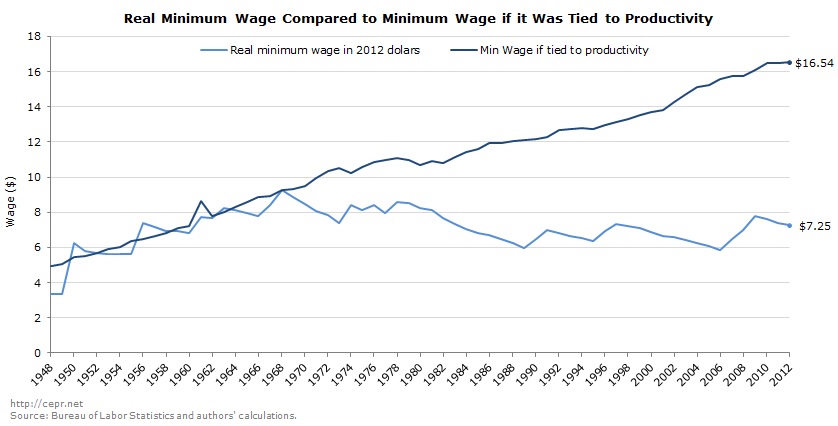
A low minimum wage also has the nefarious effect of affecting everyone up the wage scale who works for their pay, around 5% make the bare minimum or below, but it sets a benchmark for all other wages to be compared to. Someone with a four-year degree makes the equivalent of what a minimum wage worker made in the 60s. If wages had kept pace with productivity and inflation the minimum wage would be nearly $20, so what would a college grad be making? We haven't been too good about raising the minimum wage, yet prices still increase, productivity still increases. So I would like someone to show me the link between a raise in the minimum wage and all these negative effects, because the data doesn't reveal that.
When I was in Paris a Chipotle opened up and I was surprised that a burrito cost $13. But then I thought, these workers are well-paid, probably living in decent apartments in the suburbs, they have stable full-time schedules, they have health insurance, and paid vacation, and the line was still going out the door. In the US we accept crap and think its ok that the people who serve it to us should live like crap. When you travel in Western Europe you realize how poor the average American is, despite how insanely rich our country is, our housing in sub-par, we are sicker, we don't take vacations. Look at CEO pay and productivity, which grow exponentially and compare it to real wages, which continually fall. That's not ok to me, at all.
If income inequality is the issue of our time, and its getting worse, then what other solution is there than raising taxes and raising the minimum wage, which was designed to provide the least skilled workers a dignified minimum standard of living; a living wage. We may still worship at the alter of upward mobility, bootstraps and ambition, but the US is increasingly the least socially mobile country, has the most entrenched wealth, and the highest income inequality.
People are suffering and need relief and they could care less about proving their mettle at the fry station when they know they are going to leave their full-time job with their food-stamps and head to Walmart. If service jobs are the new mining and factory jobs then for the sake of workers and for the economic health of the US they need to be living wage jobs.
vendredi 3 octobre 2014
My Take on the Death of the Middle Class
I
was reading some articles on the death of the middle class and the
reasons why, I will post here below. Also some articles on the hidden
rich in America, and I decided to do some quick calculations. I googled
who the richest actor is, people we generally think of as the richest of
the rich, Seinfeld topped the list at 825 million. Then I looked up
simply the richest American, and no surprise it was Bill Gates at 81
billion. So 100x more than the richest actor.
I also read in one of the articles that the starting wage in the early 60s in say a steel mill, shoveling coal into a furnace for 8 hours payed in today's dollars $17/hour. Essentially an annual salary of $32,000 today. Some of you might be thinking that looks like the average starting salary for an entry level position requiring a Bachelors. Because I did. Which leads me to one of two conclusions: 1. jobs are vastly underpaid for the skills and education they require and employers are getting a great deal on labor; or 2. jobs require a bachelors degree the way that jobs of yore only required a high school diploma.
We need to figure out why our skills and education, which are harder and harder to come by, keep losing value, or we need to make undergraduate education free again (like it mostly was in the 60s) as it is the new minimum. Although that doesn't take into account fast food and retail, unless you add the loss of unions into the mix. Some economists want to scare us into believing that if we raise the minimum wage, which would be $20 today had it kept up with inflation, we would have high prices and fewer jobs, but the only tangible result I can see from all the data I have looked at shows the ability to lower wages at the low end of the wage scale drags all other wages down with it.
Now we are at a point where a computer programmer fresh out of college in 2014 can expect to make the same amount as a high school drop-out shoveling coal into a furnace in 1962 who walked in off the street. And the kicker, the computer programmer in 2014 probably has about $35,000 in student loans to pay back.
http://www.salon.com/2013/09/20/rip_the_middle_class_1946_2013/
http://www.salon.com/2013/12/30/the_middle_class_myth_heres_why_wages_are_really_so_low_today/
http://www.salon.com/2014/07/21/clueless_rich_kids_on_the_rise_how_millennial_aristocrats_will_destroy_our_future/
http://www.salon.com/2014/09/29/the_big_middle_class_rip_off_how_a_short_sale_taught_me_rich_peoples_ethics/
I also read in one of the articles that the starting wage in the early 60s in say a steel mill, shoveling coal into a furnace for 8 hours payed in today's dollars $17/hour. Essentially an annual salary of $32,000 today. Some of you might be thinking that looks like the average starting salary for an entry level position requiring a Bachelors. Because I did. Which leads me to one of two conclusions: 1. jobs are vastly underpaid for the skills and education they require and employers are getting a great deal on labor; or 2. jobs require a bachelors degree the way that jobs of yore only required a high school diploma.
We need to figure out why our skills and education, which are harder and harder to come by, keep losing value, or we need to make undergraduate education free again (like it mostly was in the 60s) as it is the new minimum. Although that doesn't take into account fast food and retail, unless you add the loss of unions into the mix. Some economists want to scare us into believing that if we raise the minimum wage, which would be $20 today had it kept up with inflation, we would have high prices and fewer jobs, but the only tangible result I can see from all the data I have looked at shows the ability to lower wages at the low end of the wage scale drags all other wages down with it.
Now we are at a point where a computer programmer fresh out of college in 2014 can expect to make the same amount as a high school drop-out shoveling coal into a furnace in 1962 who walked in off the street. And the kicker, the computer programmer in 2014 probably has about $35,000 in student loans to pay back.
http://www.salon.com/2013/09/20/rip_the_middle_class_1946_2013/
http://www.salon.com/2013/12/30/the_middle_class_myth_heres_why_wages_are_really_so_low_today/
http://www.salon.com/2014/07/21/clueless_rich_kids_on_the_rise_how_millennial_aristocrats_will_destroy_our_future/
http://www.salon.com/2014/09/29/the_big_middle_class_rip_off_how_a_short_sale_taught_me_rich_peoples_ethics/
vendredi 19 septembre 2014
The Scottish Referendum
 The results for the Scottish referendum are in, and it appears Scotland
will remain in the UK (55%). This has been a very interesting campaign
that I followed closely out of political curiosity (I wrote my thesis on
the nation-state) and personal interest as an EU citizen. This could
have set a very interesting precedent. But even though the UK will live
on perhaps it sets an important precedent in that national governments
will take the concerns of their citizens seriously and implement
policies that reflect their values.
The results for the Scottish referendum are in, and it appears Scotland
will remain in the UK (55%). This has been a very interesting campaign
that I followed closely out of political curiosity (I wrote my thesis on
the nation-state) and personal interest as an EU citizen. This could
have set a very interesting precedent. But even though the UK will live
on perhaps it sets an important precedent in that national governments
will take the concerns of their citizens seriously and implement
policies that reflect their values.The Yes campaign was very clear that they do not want to live in a country of individuals, in it for themselves, with state resources going to those who already have all they need. They want to be a Scandinavian style democracy where the country's wealth (oil and financial) is used to lift all people. A large number of people spoke out against neo-liberal policies championed by London and Washington that see corporations and countries richer than ever and the average citizen struggling more and more.
So I will continue watching this space to see what tangible reforms are implemented and if the rest of the UK takes notice of what people power can do and demand better from their government as well.
Inscription à :
Articles (Atom)